
Your December Holiday Party Is Already Behind Schedule
Here’s What to Do Right Now
I know. It’s not even fall yet. The last thing you want to think about is December.
You haven’t processed summer. The holidays feel like someone else’s problem — a future-you problem. And honestly? That’s a completely reasonable way to feel.
But here’s what I’m seeing right now, actively working on proposals for December events across Houston: venues are already gone. Not “going.” Gone. Some of the best private event spaces in the city have one — maybe two — December weekends left on their calendar. A few have none.
So while future-you is sipping pumpkin spice in October finally feeling ready to think about the holiday party, current-you is about to be making decisions from whatever’s left. And in corporate holiday party planning, what’s left is never what you wanted.
This post is the nudge. Consider it received.
This applies whether you're planning a holiday party, a client appreciation dinner, an end-of-year awards night, or a fundraising gala.
Why Houston Holiday Venues Book So Fast — And Why This Year Feels Different
Corporate holiday party planning in Houston operates on a compressed timeline that most organizations don’t fully understand until they’ve missed their first-choice venue for the second time. For December events with 50 or more guests, quality Houston venues — hotel ballrooms, private event spaces, rooftop venues, country clubs — book out 6 to 12 months in advance at the premier end. That window opens in January and closes faster than most internal planning teams expect.
This year, I’m watching it happen earlier than usual.
After 15+ years planning corporate events across Houston’s oil & gas, real estate, healthcare, and technology communities, I’ve rarely seen December availability this compressed by mid-year. The December Fridays and Saturdays — the dates every company wants — are already spoken for at the majority of premier venues. What’s left are weeknights, early December dates, and secondary spaces that weren’t anyone’s first choice.
This isn’t a scare tactic. It’s what I’m actively navigating for clients right now.
The companies that lock in a great venue in September and October? They’re making decisions from a position of strength — choosing the space that fits the vibe, the budget, and the guest count they actually have. The companies that start in November? They’re choosing from what’s available. Those are very different conversations to be in.
What “Starting Too Late” Actually Costs You
Most organizations don’t realize they started too late until they’re already in the cascade of compromises.
It goes like this: the venue that fits the budget doesn’t quite fit the vibe. The caterer you actually wanted is booked, so you go with your second choice — the one you’ve never worked with before. The AV company that was recommended by three people is unavailable, so you’re vetting someone new under time pressure. Each individual compromise feels manageable in isolation. Together, they produce an event that’s fine — technically fine — when it could have been exceptional.
This is what I call the “late start cascade,” and it’s one of the seven most costly mistakes I see organizations make when planning events internally. The event doesn’t fail dramatically. It just quietly underdelivers on what it had the potential to be.
The budget was spent. The hours were invested. The event happened. It just didn’t do anything memorable.
For Houston’s oil & gas and energy companies specifically — where budget approvals come late and executive schedules shift — this risk is amplified. The organizations that navigate this well don’t wait for internal alignment before engaging a planner. They bring a planner in early, often 6 to 12 months out, so that when the green light finally comes, the vendor relationships are already warm and the options are still open.
The Corporate Holiday Party Planning Timeline Houston Organizations Should Be Following
The organizations that consistently produce exceptional events don’t start when they feel ready. They start before they think they need to. For a December event, here is what the ideal planning timeline looks like — and what should be happening at every stage.
12 Months Out — Set the Foundation
Your annual event calendar is confirmed, budget is earmarked, and if you’re using outside support, a planner is engaged. This isn’t premature — it’s what allows every subsequent decision to be made from a position of choice rather than constraint. The organizations that consistently get the venues and vendors they actually want are the ones who have this conversation in January, not October.
9 Months Out — Define the Experience
Venue shortlist is identified and site visits are scheduled. More importantly, the event objective and experience concept are defined in writing. What do you want attendees to feel when they leave? What is the one thing you want them to remember? Every vendor decision that follows should be an expression of those answers. Decisions made without this foundation are just line items on a spreadsheet.
6 Months Out — Lock the Essentials
Venue is contracted and deposit is paid. Anchor vendors are identified — catering, AV, photography. Save-the-date communications are sent. At six months out, your most important decisions should already be behind you. If you’re just starting your venue search at this stage, you still have options — but they’re narrowing. Move quickly.
90 Days Out — Build the Infrastructure
Full event budget submitted with all hidden cost line items accounted for: gratuity (20–22% of catering spend), AV overage rates, parking validation, event staffing, and a 10% contingency reserve. Guest invitations sent or in final production. Event agenda drafted and approved by leadership. Planner fully engaged if using outside support.
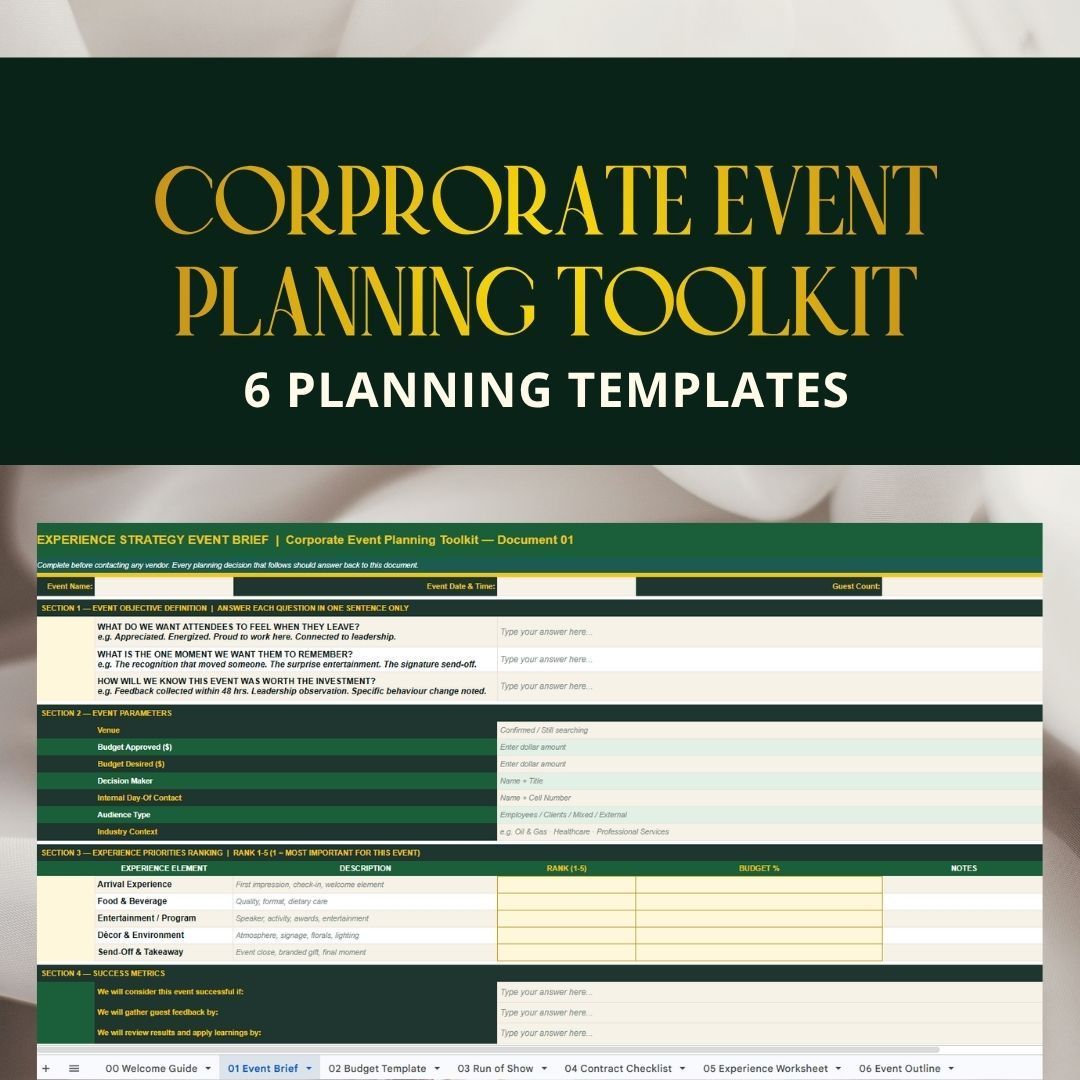
If you want the exact budget template I use with hidden cost line items pre-built, it’s inside the
Corporate Event Planning Toolkit. Nothing shows up as a surprise on your final invoice.
60 Days Out — Confirm Everything
All primary vendors confirmed and contracts signed — catering, AV, photography, entertainment. Menus in review. Hotel room block secured if applicable. At this stage the plan shifts from building to managing. Every major creative and logistical decision should already be made. If something isn’t confirmed at 60 days, it becomes a risk.
30 Days Out — Lock and Load
Final headcount confirmed. Run of show drafted and distributed to every vendor and stakeholder. All vendor details locked — final menus confirmed, AV requirements submitted, staffing assignments finalized. Promotional items ordered with 2–3 weeks minimum for production. This is execution mode. The event is already designed — now you’re making sure it happens exactly as planned.
48 Hours Out — Final Check
Final vendor confirmations in writing. Day-of timeline distributed to all stakeholders. Contingency plan reviewed. Every vendor contact number compiled in one document. The person managing the event on the day is fully briefed and ready — and ideally, that person is not also expected to attend as a host.
The Mistake Most Companies Don’t Catch Until the Day Of
Here’s the one nobody talks about in the context of holiday planning: the person who planned the event almost always ends up running it, too.
In corporate environments — whether that’s an EA managing the holiday party for a 300-person energy company or an HR director coordinating a healthcare team celebration — the planner and the host are usually the same person. Which means the person who worked 40 to 80 hours to make the event happen is also on a headset chasing vendors while their colleagues are taking photos and actually enjoying the evening.
This is its own costly mistake. And it’s entirely avoidable.
When you engage a professional corporate event planner, you attend as a host. You’re present for the conversations that matter. The ROI of having a planner isn’t just organizational — it’s personal.
For Houston’s real estate, technology, non-profit, and corporate communities, this is often the tipping point in the decision to work with outside support. Not because the internal team can’t plan a great event — they often can. But because nobody can plan a great event AND host it simultaneously.
December Is Coming. Here’s What to Do This Week.
If you have a holiday party on the calendar — or on the idea board — for December, the ideal window to have started was six months ago. The next best time is right now. Here is what matters this week, in order:
1. Confirm your date and headcount range.
2. Define your non-negotiables.
3. Start your venue search today. Need a venue? Get our Houston Venue Guide with 350+ venues
4. Engage a planner if you’re using one. Need a planner? Send us an inquiry
Even a rough headcount estimate (150–200 guests) gives venues enough to quote you accurately. The clearer you are on non-negotiables — venue type, atmosphere, location within Houston, parking requirements — the faster the search moves. December availability in Houston is thinning weekly and the good dates go to whoever moves first.
That timeline does not work. I see it every year and I watch organizations make exactly the compromises described above — not because they didn’t care, but because they ran out of runway.
NOT SURE WHERE YOUR PLANNING PROCESS STANDS?
If you’re looking at this list and not entirely sure which of these mistakes your organization’s current process is most vulnerable to — that’s exactly what the free Corporate Event Readiness Assessment is designed to tell you.
It takes 10 minutes. You answer 7 questions about your planning process. You get an instant score across five planning categories, plus the full PDF guide — “7 Costly Mistakes Organizations Make When Planning Events Internally” — which walks through every mistake with a concrete fix.
TAKE THE FREE CORPORATE EVENT READINESS ASSESSMENT
Already know you want support for your December event? I have limited availability remaining for corporate holiday events this season across Houston.
SEND AN EVENT INQUIRY
Ready to stop planning under pressure and start designing an experience worth attending?
FREQUENTLY ASKED QUESTIONS
How far in advance should you book a venue for a corporate holiday party in Houston?
For December corporate holiday parties in Houston, quality venues should be booked 6-12 months in advance if possible— meaning by June for December events. In Q3 & Q4, premier venue availability narrows significantly. Organizations that begin the venue search in October or November are often choosing from secondary options rather than their preferred spaces.
When is it too late to plan a corporate holiday party in Houston?
It is not too late to plan a December holiday party in Houston through early fall, but options narrow significantly after October. By November, most preferred private event venues have limited or no December weekend availability remaining. November is still workable for weeknight events or smaller gatherings, but organizations planning for 50 or more guests should begin the process no later than September.
What is included in a corporate holiday party budget that most organizations miss?
Corporate holiday party budgets frequently omit gratuity (20–22% of catering spend), AV overage rates for events that run past the contracted end time, parking validation for guests, event staffing costs, and a 10% contingency reserve. On a $10,000 catering contract, gratuity alone adds $2,000–$2,200 that most initial budgets never account for.
What does a corporate event planner in Houston do for a holiday party?
A corporate event planner in Houston manages the full planning process — venue sourcing, vendor contracting, budget management, experience design, logistics coordination, and day-of execution. For holiday parties specifically, an experienced planner brings existing vendor relationships, knowledge of current venue availability, and the ability to run the event on the day so internal team members can attend as hosts rather than coordinators.
How do oil and gas companies in Houston handle last-minute corporate event planning?
Oil and gas companies in Houston often operate on compressed decision timelines — late budget approvals, shifting executive schedules, and headcount changes close to the event date. The best approach is to begin venue and vendor sourcing earlier than the internal timeline would suggest, book vendors with clear amendment and flexibility policies, and engage a corporate event planner experienced with O&G organizational dynamics.
SHARE POST:
Checkout Other Posts